

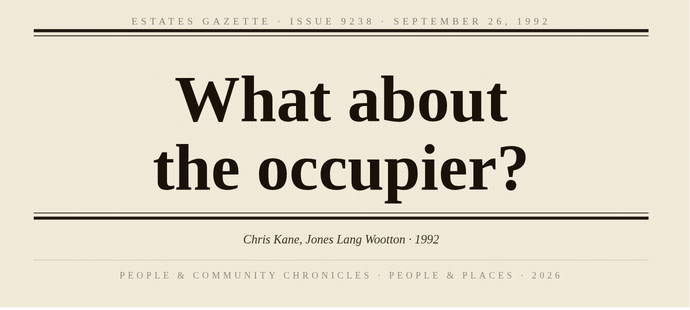
What a 1992 question in the Estates Gazette got right, and what it took thirty-two years to prove
Recently, I came across a short piece I wrote for the Estates Gazette way back in September 1992, under a deliberately simple headline: What about the occupier? It is hard to imagine that as a junior partner at what is now JLL, I was kicking off a career-long advocacy for the end user of buildings. It is interesting to reflect on how the sector has evolved over the last three decades but I believe we still have a way to go in truly understanding the people dynamic. That is the rationale for this series of essays: to throw light on the topic, and to make better use of the built environment as a result.
Casting my mind back to the nineties, I was forming a very different view of my industry compared with the majority. It was mostly influenced by the American computer companies and other multinationals I was advising at the time. It was hard not to be frustrated by what I was seeing large, sophisticated organisations with serious property requirements being offered buildings that simply did not work for them, designed to a specification pre-determined by financiers that rarely considered what the people actually using them needed. One building, considered perfectly acceptable by the market, had toilet facilities on only two of its three floors. Thankfully, things have moved on. A lot.
I did not fully realise it then, but asking that question turned out to be a career.
This piece of archive material has prompted so many memories but it also provides a curious and useful chronology of the ever-changing needs of the corporate end user, and how the supply side has evolved in response. It was already visible in 1992, if you were paying attention, that there was a clear mismatch between what tenants required and what the speculative sector was prepared to provide. SmithKline Beecham a major pharmaceutical company in the middle of a significant headquarters search chose a campus of four buildings at The Fountains on Brentford’s Great West Road, not because it was the most prestigious address available but because it fitted their people, their culture, and the way they intended to work. It was close to their existing outdated premises, which reduced the potential for staff disruption. Their space planners concluded that separate buildings would serve their particular purposes better than a single structure under one roof. Flexibility and customisation were critical. Accessibility to their existing labour force mattered. And their personnel managers were already making an argument that would take the rest of the sector another three decades to accept: that staff yield a better performance in a better location.
The Estates Gazette pulled one line from the article as a sidebar quote. It read: “There is frustration building up within corporate occupiers and with little prospect of it receding.” Thirty-four years on, I wonder whether that frustration has been fully resolved. What I can say is that there is clear evidence of the benefits of taking the frustration out of the process. A good example of exactly that arrived in 2024. And it came, of all places, from Brentford.
The long road back to the city
SmithKline Beecham became GSK in December 2000, when it merged with Glaxo Wellcome to form one of the world’s largest pharmaceutical companies. Two years later, GSK opened a new global headquarters at 980 Great West Road, just down the road from The Fountains, still in Brentford, still on the same stretch of west London arterial that the 1992 article had documented. Tony Blair opened the building. It cost £300 million and housed three thousand administrative staff. It was, by any measure, a serious piece of corporate real estate.
And then, in 2021, GSK announced it was leaving.
The company was splitting into two. GSK House, as it had become known, was sold to a London regeneration specialist, and it is interesting to note that the recently announced proposals for the site offer a far more community-focused proposition than the monolithic corporate headquarters it once was. The reason for vacating was straightforward: the building was too spacious for either of the two successor businesses. But there was a deeper logic at work, one that any objective reading of the 1992 article would have predicted. The era of the monolithic corporate headquarters, one organisation, one building, fixed in place, optimised for headcount rather than human activity, was ending. The explosion of hybrid working post-Covid accelerated what was already becoming inevitable. The market was beginning to understand it.
In late 2022, GSK announced where it was going. Not to a business park. Not to a campus on the periphery. To the corner of New Oxford Street and Earnshaw Street in central London, a new building, designed from the ground up for hybrid working, targeting a BREEAM Outstanding rating, chosen specifically for its proximity to the Knowledge Quarter, the Francis Crick Institute, and King’s College London. The CEO described it as a place where GSK people could meet, collaborate, and ultimately deliver solutions for the urgent healthcare challenges facing the world. She noted, almost in passing, that it marked a return to central London, to the city where the company’s origins lay, in a Plough Court pharmacy established in 1715.
GSK moved in 2024. Three thousand staff. A hybrid model. A building designed around what people actually need to do their best work, in an environment that connects them to the knowledge networks, the community, and the city that make that work possible.
Read that list again. Collaboration. Knowledge proximity. Transport accessibility. Sustainability. Wellbeing. Human-centred design. Every criterion GSK cited in 2024 was already visible in The Fountains decision of 1992. The language has evolved. The logic is identical. It is a striking observation, and one worth sticking with as this series unfolds. Were the space planners of 1992 simply ahead of their time, or were they just paying closer attention to people than the rest of the sector was prepared to? Has the industry truly caught up? And are the funding and investment constraints of the development model still the primary consideration, still crowding out the human one? Plenty to mull on. That is rather the point of this series.
Why this series exists
I have told the GSK story here not because it is a property story, though it is that, but because it is a human one. It is the story of an organisation that consistently, across three decades and three corporate identities, asked what its people needed from a place and then built around the answer. That is rarer than it should be. And it is the reason this series exists.
People & Places has been making the professional argument: the laminar world, the fixed-flex-fluid spectrum, the convergence of CRE, HR and IT into a single integrated framework. That argument will continue, and it matters. But professional argument reaches the people who already accept the frame. It speaks in the language of the sector. And the sector, as 1992 demonstrated with some clarity, can understand a language perfectly well and still choose not to act on it.
People & Community Chronicles adds the human dimension to the mix. Because the relationship between people and place is not fundamentally a CRE problem, it is a human one, felt in regeneration schemes and sports clubhouses, in post-conflict cities and pharmaceutical campuses, in communities that have lost their anchor and are trying to find it again. The evidence has always been there. What has too often been missing is the willingness to let people lead the brief.
This series will carry that evidence in the only form that truly lands: stories. Not case studies dressed up as human interest. Not data points with a human face. Stories, observed, lived, sometimes uncomfortable, in which the argument is carried by the material itself, not stated separately from it. The point will be made through the story, not after it.
Everything connects
Leonardo da Vinci observed that everything connects to everything else. It was not a philosophical flourish. It was a method, a disciplined way of seeing that refused to treat any system as isolated from the systems around it. People & Community Chronicles operates on the same principle, and it will range accordingly.
A headquarters decision in west London is also a statement about what kind of employer an organisation intends to be, what kind of city it wants to be part of, and what kind of community it sees itself as belonging to. GSK’s 2024 move is not just a property story. It is a story about knowledge networks and urban ecosystems, about the relationship between corporate investment and civic life, about what happens to a place, to Brentford, to the people who worked there and the local economy that depended on them, when a major employer moves on. These are not peripheral questions. They are the questions that People & Community Chronicles will keep asking.
The series will move between scales. The institution and the community. The city and the neighbourhood. The workplace and the street. The argument at its sharpest is not just that people matter in corporate real estate, though they do, and the sector has been slow to accept it. The argument is that people, place, and community form a single connected system, and that decisions made in any part of that system ripple through all of it. Charles Handy, fellow Irishman, fellow contrarian, once said to me that the organisations which endure are those that remember they are communities of people before they are portfolios of assets. The property sector has spent a generation inverting that order. This series exists to put it right.
The invitation
The Coalition of the Convinced does not wait for consensus. It starts with a question, what about the occupier?, asks it clearly enough that the sector cannot pretend not to hear it, and invites others to push back, extend, and improve the argument. That is what this series is. The missing link is not hard to find. It has been there all along, in the people the sector keeps forgetting to put first.
Thirty-four years ago, a young partner at Jones Lang Wootton wrote a short article in the Estates Gazette and was met, more or less, with silence. The question was right. The sector was not ready then. Is it ready now?
Pull up a chair. This is where People & Community Chronicles begins.
Chris Kane is the author of Where is My Office? (Bloomsbury, 2020 & 2023), provides advice at Chris Kane Associates, and former Head of Corporate Real Estate at the BBC. He writes at People & Places on Substack.